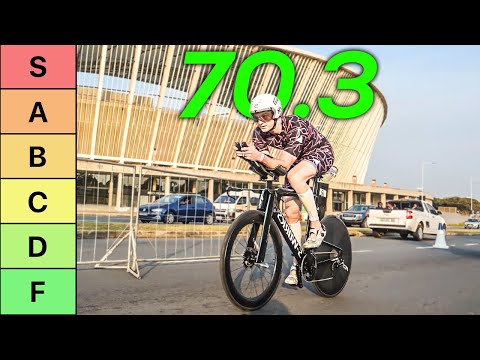

Most 70.3 (half Ironman) triathletes are wasting many hours each week training for a race they care deeply about, and still underperforming.
In this article I'm going to help you shave three, four, maybe five hours off your training week and actually gain some speed. The big myth is that more volume makes you faster. You're probably dead wrong.
You've got a job, a family and a 70.3 goal you care deeply about. So I'll break down some of the myths and give you some ideas on how you can get some of your time back and actually get faster.
1. Stop Following a One-Size-Fits-All Training Plan
Most triathletes I meet are fit - don't get me wrong - but they're very fragile. They're following a training plan that doesn't work: a one-size-fits-all plan off the shelf. You end up doing a lot of zone 2 junk miles. What do I mean by that? Just getting out for a bike ride with no structure and no strategy, doing a lot of easy training.
Don't get me wrong, easy training is required to build your aerobic engine, certainly in the early years and months. But when you're limited to six to eight hours a week - probably the sweet spot for most amateur 70.3 triathletes - with the other demands of life, like not compromising sleep, nutrition, recovery and food preparation, you have to get much smarter with how you structure your training, and more specific.
It's not just about doing a lot more volume, because that digs a hole. You compromise sleep. You're probably all nodding - you squeeze that extra session in, and you certainly push nutrition to the side. And the fuelling around your sessions is actually even more important than the session itself, because the adaptation is when you get fitter.
The training session itself does not make you better. The adaptation afterwards does.
So you're working hard all the time, but is all that effort adding up to better gains, or are you just making yourself more fatigued? You arrive at the event overcooked, not fresh, and your performance is below par.
Look at your week, Monday to Sunday. Over the first six to eight hours there's a nice linear improvement in the stress you put on the body. You tend to plateau around the eight-hour mark because of compromised recovery, and the drop-off can be very hard and fast once you go past eight hours a week.
2. Build Your Week Around Three Key Sessions per Sport
A really good place to start is a simple 3-3-3 model: three sports, three sessions per sport, around three hours per sport.
Take your three swims. You get more done in 20% of the time, for almost 80% better gains, if you structure the sessions really specifically. The same goes for biking - we know we need a little more time on the bike - and the same with running. If you consistently hit those three sessions per sport, you also limit injury, because that's where you get exposed to injury so much more.
Tailor your week so it hits these sessions as key fundamentals. They are non-negotiable - do not miss them. Everything above that, your mobility and your strength work, is designed to support the swim, bike and run: three one-hour sessions for each of the three sports.
There's also no point having this structure if you hit those sessions half dead. If your energy is really low, either because it's too early in the morning and you've compromised your sleep, or because you haven't fuelled the session properly - and we've all been there, myself included - you get below-par quality out of the session. That's what I'm talking about when I say the average triathlete isn't hitting the correct intensity.
When you've got tons of volume, fantastic, you will improve. But most of us only get that now and then, in a week where we get a training camp and might do 20 to 25 hours. That week is quite degrading and doesn't really build much in the grand scheme of things - it just messes up your consistency. String two or three weeks of that together and that's where you get the big gains. That's where professional athletes can obviously do a lot more volume and recover.
3. Plan Your Week Around the Non-Negotiables
So you have to start with your week: its specificity, its planning and its structure. Not every week is the same, because of travel and work. Start with the non-negotiables - kids and family commitments. You've got to sacrifice some social elements, I'm afraid. To win somewhere, you've got to lose somewhere else.
Protect the key sessions
Your key sessions are the non-negotiables. An easy run and an easy bike can drop away - they're supporting sessions. But those three key swim sessions need to be slotted in, non-negotiable. They could be tagged onto a bike session or a run, which is no problem.
Put your long run in the middle of the week
Ask yourself when you're most tired. Generally people are quite fatigued from the week by Thursday and Friday. But if you've got a gap on Wednesday morning, and you only have to start work at 10:00 a.m. or can move your diary, do your long run on a Wednesday.
We do a long run back to back after a long bike at the weekend simply because that's when we traditionally have more time. But I can get a lot of my age-group athletes to do their long run in the middle of the week. That gives me two lighter days, so then I can hit them with some decent biking at the weekend, and the improvements are quite linear from there.
Use the weekend for the big sessions
Generally speaking, you have more time on a Saturday or Sunday - weather dependent, and around kids, social and sport commitments, and your partner. That's when you're going to get your two- or three-hour session in, with adequate recovery afterwards.
And if you feel dead by Friday, even 30 minutes is worth it. I promise you that blood flow, that LT1 - your first turn point, the real aerobic conditioning that makes up 80% of your training week - should fit in there. It's still worth going out. It's not junk. It's blood flow, it's mindfulness, and it sets you up for the weekend.
4. Make Intensity Your Ally (But Only When It's Precise)
Intensity is your ally, but only when it's precisely executed. It's something I neglected in my 20s, probably. I'm in my 40s now, and I thought I was doing intensity back then, but I wasn't doing it correctly. It's your bang for your buck.
It also goes back to a point I made in another video: VO2 max and strength are two of the leading determinants in preventing all-cause mortality.
What high intensity really means
High intensity means efforts of three to five minutes, sometimes up to eight, whatever sport you're doing, where you're in that intense domain. In a three-zone model that's zone 3; in a seven-zone model, if you're using TrainingPeaks, it's above zone 5. It's hard, and you're out of breath.
Most of us can only manage two- to three-minute intervals. You then need equal rest, and you can probably handle three to five repetitions. That should be in your programme each week. If you're injured on the run, don't do it there - you can do it in the swim. Biking is probably your best bet, and you can use a hill.
The group ride trap
If you're out on a group ride and you think that's going to be intense because you're surging off the front, that's the problem with Saturday group rides. Everyone's got their ego in. You go to the front, you hold that position, and it starts to burn. That's the grey area. No one is really putting themselves on the line and doing three, four, five minutes repeatedly, very hard, properly above their threshold.
Know your threshold
If you don't know what your threshold is, don't worry too much. Ultimately we all have a capacity where we can hold something for 45 to 60 minutes. That's classed as your critical threshold, or your FTP - different terminology for the same idea. We test all our athletes. Sometimes you don't need a lab test: we can do field testing at home, on the turbo or on the road, across multiple parameters, to work out where your strengths and weaknesses lie.
The key is then to spend enough time above that critical point to stimulate something we know starts degrading from around 35 onwards. Keep it alive - use it or lose it - and it will be critical to your performance.
You can only handle a few hours of this a week - not even up to two hours in total, so probably two sessions a week across the sports. That's how you can see you'll be fresher for those sessions if you bring your volume down. If you're doing 12 or 14 hours a week of just easy stuff, you're getting slower and plateauing, even if you feel you're getting fitter. That can help in the early months and years of your development, of course, but you have to build up volume and frequency first before you add intensity - one of the crucial rules of training.
Properly executed intensity, in your right zones, is 100% your key ally in performing. You'll find you do less volume and actually get faster.
5. Treat Recovery as Training
The most important thing: recovery is actually training. Let's be blunt - if you're not recovering properly, whether that's active recovery or actually sleeping, you're going backwards.
Sleep comes first
Sleep is your best free tool, hands down, and every expert agrees. If you're terrible at sleeping, you need to address that first. If you've ever trained late at night, you'll know it: swim late at night and your sleep is terrible; do a hard bike in the evening because that's the way your diary works and you'll sleep poorly. Once, in isolation, it's not going to really affect you. But if you do it repeatedly, you need to work your diary better.
Feed the machine and watch your data
The athletes I coach really prioritise recovery. That means feeding the machine and getting the timing of meals right. There's no magic diet - it's complex macronutrition, with variety around their training. Certain carbohydrates can help recovery and absorption because they're less fibrous, and adequate protein intake matters too.
Monitor your wearables and your actual recovery through the night on a weekly basis. Whoop or Oura data is becoming more available for most of us, and people are more aware of it. Track how the training is affecting you and whether you're recovering, on a three- to four-day scale, maybe even over seven days. If you're still trending downwards and just don't feel yourself, you've got to back off.
That's about adjusting your training in real time, and it's where an off-the-shelf training plan falls down, because it doesn't take anything like that into account. The same goes for AI plans, which work for perhaps 30–40% of people. If you're looking for true performance, certainly with the athletes we coach, it's about adjusting in real time. If you layer consistent sessions on top of each other each day - sometimes double days, sometimes triple days - the body loves that high frequency and they improve drastically. They treat recovery as the fourth discipline, and nutrition is 100% one of the most important parts of it. Recovery equals adaptation, which means you get better.
Prioritise bed and naps over squeezing in a session
So rather than trying to squeeze in more sessions - we've all been there - I'd rather you prioritise getting to bed 90 minutes earlier. Not necessarily sleeping in, because your body likes a consistent wake-up time.
Even if you're quite tired, I almost prioritise a 20- to 40-minute nap later that day. You can do it on the train on the way to work (don't do it while driving), and ideally not later than 2 or 3 p.m. Even if you take it out of your working day, you'll be so much more productive at work. People frown and ask how they can have a 20-minute nap, but there are companies that allow it. If you work from home, it's the most productive way: I often duck off for 20 minutes, set my alarm, and you feel revitalised. Go over 40 minutes and you start to play with your sleep cycles and wake up more groggy.
Warm-ups, cool-downs and fuelling
Skipping warm-ups and cool-downs can add up over the week and multiply, so focus on why we do these things. The warm-up is really important. Extending a super long cool-down isn't actually that beneficial - you're best dropping it down, as you just want to flush some of the lactate out. It depends on the intensity of the session.
Fuelling before sessions isn't always required, and you don't want to over-fuel for the sake of it. But a lot of sessions will require some carbohydrate, so it's about understanding the right time, the right fuel and the context of your fuelling.
Frequently Asked Questions
How many hours a week do you need to train for a 70.3 (half Ironman)?
For most amateur 70.3 triathletes, six to eight hours a week is the sweet spot. Progress tends to plateau around eight hours because recovery gets compromised, and going past that can drop off hard and fast. A good place to start is three sessions in each of swim, bike and run.
Can you get faster for a 70.3 by training less?
Yes. You can train 15 hours a week and still plateau, but eight hours of really focused, structured training can still make you faster. Properly executed intensity in the right zones means less volume and more speed.
How much high-intensity training should I do for a 70.3?
Efforts of three to five minutes, sometimes up to eight, with equal rest and three to five repetitions - probably two sessions a week across the sports, and not even two hours in total. Build volume and frequency first, before you add intensity.
When should I do my long run in 70.3 training?
Consider the middle of the week. We often run long straight after a long weekend ride simply because weekends have more time, but a Wednesday long run gives you two lighter days, so you can hit a decent bike session at the weekend.
How important is sleep when training for a 70.3?
Very. Recovery is training, and sleep is your best free tool. If you're terrible at it, address that first, and avoid regularly doing hard sessions late at night. Prioritise getting to bed 90 minutes earlier over squeezing in another session, and consider a 20 to 40 minute nap before 2 or 3 p.m.
Final Thoughts: Train Smarter, Not Longer
In summary, you can train 15 hours a week and still plateau. But you can also train eight hours of really focused, structured training for your physiology and still get faster.
I've seen it with other coaches and their athletes, who've dropped their volume down, and I've seen it with some of my own athletes. When they're ready, we increase their volume if that's what we need to do. But if they're still improving and their numbers are right on that formula, why would we change it?
I hope that's given you some food for thought on how you look at your week. If you'd like help shaping a plan around your own time, get in touch.