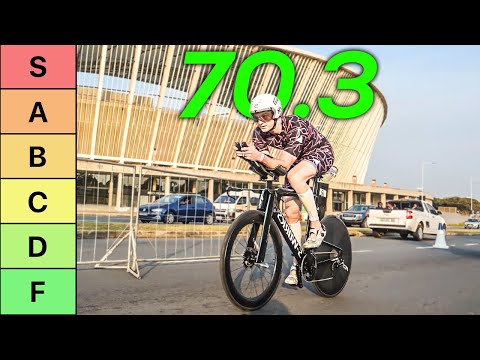

Did you think you had to train 30 hours a week for a full-distance Ironman?
This is the exact training plan that took Jim from an average triathlete to a sub-10-hour Ironman on roughly 10 hours a week. In this article I'll go through a detailed prescription of training, and how to identify where you need to spend most of your time so you use it smartly and efficiently, given how little of it you have.
It isn't just one athlete that it's happened to by chance. It's happened to me, and many Ironmans have been done on around 10 hours a week, finishing close to 9:30 on race day. I do have a bigger training history and training age than perhaps a lot of athletes reading this, so keep that context in mind.
I'm going into quite a lot of detail here, unlike some of my shorter, more generalised content. As we approach winter training and the off-season in the northern hemisphere, it's a timely one: now is a good time to think smartly through winter, get the best gains, develop really good habits and carry them into the early part of next season.
If you're here, you're probably intrigued by the mythical 10-hour pathway and what it actually takes to break it. Perhaps you've already done an 11- or 12-hour Ironman and you think you need to train 30 hours a week to go faster.
1. Reverse Engineer From Your Goal Race
Let's say your goal race is in October, 12 months away. Start with what needs to be achieved in the swim, the bike and the run, plus some wiggle room in transitions depending on your race. At Ironman Barcelona, for example, if you're swift it's only a 2 to 3 minute transition in T1 and 3 to 4 minutes in T2. If you keep your transitions under 8 minutes, you're well on your way to a good performance. And remember, you can actually train transitions - it's a pure, free speed skill.
We all have different starting points with our swim, our bike position and our run history, so the first thing is to make the most important thing for you the priority. You'll hear me say that context is key, and I'll repeat myself a few times.
Jim's story
Jim had done a couple of Ironmans with poor performances on the run, always the usual suspects: feeling sick, vomiting up his nutrition on the run, resorting to walking, and really struggling with leg fatigue and an overall mental breakdown well into the first half of the run. A really strong biker - the classic swim-bike combo - and the rest is history.
If you've been in this boat, you're fine on the swim and the bike, and fine on the run until about 18 to 25 km. It's almost always that point in the race, at about seven hours, where everything falls apart. I'll come back to fuelling and fat oxidation, but we want to mitigate that with a really short stimulus time of training: the amount of time you have, but super effective and very specific to you.
This is where a coach usually comes in, because you don't know where to start. Hopefully I'll give you some tools to at least make a really good start on your own. I urge you to just start, take ownership, and have a deep, honest, hard look under the bonnet to see what's really going on: the physiology, the habits and the mental side.
2. How to Split Your 10 Hours
You might say "10 hours? Wow - how?" First, a broad overview of how I might split it up. It isn't set in stone, just a starting point, and the numbers move up or down depending on the time of the season.
- Swim: three sessions a week, around 2 hours 15 minutes
- Bike: three sessions, around 5 hours
- Run: three sessions, around 2 hours 45 minutes
Yes, the bike looks quite low. But context is key. Eighty percent of triathletes don't come from a swim background, so their swim training age is poor and frequency is really important. If you're already swimming a 1:05 Ironman swim on two swims a week, happy days - you've got a background, a history and no shoulder injuries, so you probably don't need the extra time in the pool.
Or you might have a biking background - an uber biker who's come from cycling - and for you five hours is nothing, it's just one ride. Personally, I've done a lot of Ironmans at around 9:30 to 10 hours, and my average training has probably been 10 to 12 hours, going back 10 or 15 years. I know, for example, that I got to Kona on 10 hours a week myself.
On the run, you might be someone who picks up injuries quite often, so you have to watch your volume. I've kept the volume low but really specific. You can obviously move time from one discipline to another.
Remember, too, that this is just the triathlon training. It doesn't include strength work, which sometimes means the swim, bike and run hours have to give a little. Next I'll break down the sessions for each discipline, one by one.
3. The Swim: Three Simple Sessions
Pool training that carries over to open water
I've learned from quite a lot of different swim coaches' methods, and they're all trying to get to the same point. There's the Masters swimming programme, which is big in North America. There's the coach of Chrissie Wellington and many other female world champions, who advocates a lot of pull buoy and paddle work and muscular strength - that forms one of my sessions. I take a lot of open-water thinking from Paul Newsome of Swim Smooth, whose method I've been adopting since 2012. Bring it all together and you realise that application is key. We want really good pool training that carries over to the open water.
On Masters swimming, I find the sets are generally 3 to 4 km, an hour and a half or an hour and a quarter, and they're pretty savage. Intensity control is my big bugbear, because as a triathlete you generally turn up to the pool fatigued. Don't get me wrong, some of those swimmers are 60-plus and swimming really fast at 6 a.m. But you get pulled along in the pool. It's an inflated threshold pace, because everyone is right up your backside, and you generally train harder than you need to because you're always going on someone else's turnaround.
The pros are that it's sociable and it gets you to the pool at 6 a.m. in winter - you're letting everyone down if you don't turn up. My number one goal is to get you to the pool. If that means using a pull buoy every session because you're a weaker swimmer, so be it. For an Ironman, we need to get you realistically to a 1 hour 10 swim, which is about 1:51 per 100 m, and we'll reverse engineer that from where you are now, 11 or 12 months out. It's totally feasible. You need proper structure and commitment, and there's no fluff - it's just execution.
Alongside the pool you need the conversion to open water, so practise open-water skills pretty much all year round, even indoors in winter. Some squads allow you to take the lane ropes out for open-water skills, which is really beneficial. Keep honing those skills, whether it's a little drafting in one session, or three of you swimming in an arrowhead in a free lane, just to get used to bumping into each other. It's a really messy type of stroke, because it's not about a perfect stroke. It's about being really comfortable behind someone, next to someone, with toes in your face. That's what makes a really good open-water swimmer.
Most triathletes need a wetsuit to help them, and most triathlons are wetsuit legal - except at certain times and places like Nice, Kona and some warm races in the US, and hardly ever in the UK. That's why the coach I mentioned is such a big advocate of a big pull buoy and dinner-plate paddles for muscular strength. If your arms are falling off at 2 km in a race, it's more than likely not fitness but muscular endurance, and you're in the water for nearly 4 km. So you want really good muscular strength, but without the heart rate getting up, because you're burning precious carbohydrate.
You've heard me say in other videos that we want to spare our glycogen for the next seven, eight, probably nine hours. We have a huge amount of fat stores and a really limited, finite amount of carbohydrate, which is why we take in exogenous, external carbohydrate. The swim sets you up for your day. Swim fitness really helps your run: the energy input to the swim, and the thoracic mobility - your body's ability to move freely and fluidly in the water - carry over to your mechanics on the run. So look at photos or video of yourself running in an Ironman, see what postural issues are there, and let's reverse engineer it.
I use this methodology with myself and a few others, and I tweak it. I get my other coaches to learn how to bring it in. We keep it quite simple - I think a lot of pool sessions are overcomplicated, which leads to confusion for the athlete. Here are the three sessions I highly recommend. If you come from a swim background, two swims a week may be enough, and you can drop the basic zone 2 session.
Swim session 1: zone 2 endurance
How do we get to zone 2? Use a CSS calculator - I’ve got one here. In essence you swim a 400 and a 200 and measure it regularly, so you can monitor how you're doing over eight to ten weeks. You also want to retest, because it changes. This session is long reps of 500 to 800 m: quite long and boring, your bread and butter. You don't want to be out of breath, and you don't want to keep grabbing the pull buoy - that's for another session. You want to get comfortable at a long, steady state.
What's really good for pace control is a tempo trainer - one of those little yellow trainers under your cap - or, these days, Form goggles. Ideally you understand the clock as well, because most people lose feel for their pace and drift off, which is why relying on a watch is not always great. It's a 45-minute session, sliced up however you're comfortable with, but you're moving for most of the time with limited rest.
Swim session 2: muscular endurance
The second key Ironman session is muscular or strength endurance - for example pull buoy and paddles after a little loosening warm-up. It will take you longer than 45 minutes, so you may lengthen one swim and shorten another. Closer to the event you build towards sets like 10 × 400 m or 3 to 4 × 1 km. You want dead arms, high strength and low heart-rate load, with your body lifted up - a wetsuit swim is pretty much what you're training for in an Ironman.
You generally arrive at the pool fatigued, so sometimes we need that help from the pull buoy, and you can't get your heart rate up all the time in the water unless you come from a really good swim background. Intensity control is always quite hard in a squad environment, so take that with a pinch of salt.
Swim session 3: threshold (CSS) work
If you're an experienced swimmer you may just do VO2 work here, but otherwise do about 1,500 m of CSS or threshold work, based on your CSS pace. Start at 50s, literally at that pace, building up to 100s, maybe even up to 400s closer to the event. You want to be able to sustain about 1,500 m, even 2 km, of proper work with some fluff on either side.
Closer to the event, you want to be able to do about 38 × 100 m slightly below your CSS pace - which will be your Ironman pace - with a short turnaround of 10 to 15 seconds, and then you know you're well on your way. If you reverse engineer a 1:10 swim, it's 1:51 per 100. You want to be swimming maybe 1:48 or 1:49, which won't feel super fast for 100 m, but you're stacking them up.
In winter, if you're already quite fit and swimming 6 to 9 km a week, you might swap this for a VO2 swim to lift your ceiling a little. That's about 1,000 m of work, up to 1,500 m for faster swimmers, starting at 50 m reps and building up to 200 m or 250 m reps (three minutes or more), where your technique will start to sway. Do that in winter to raise your ceiling, retest, then work on a threshold block, then maybe come back to VO2. It isn't set in stone, but if you do this all year round with different stimulus and different rep lengths to keep boredom at bay, and you keep checking in, you'll see a change in three months. Your paces will change if you respect this and really swim how you mean to.
Squad environments make it hard. Really build your muscular strength, and you might find it too difficult to do all of this straight away, because it'll take you over an hour. Play around with the 2 hours 15 - some weeks you might do a little less. Let's face it, you normally skip a swim because it's a bit of a hassle, so realistically it's two swims a week. Ditch the easier stuff and maintain the quality.
4. The Bike: Three Sessions, About Five Hours
You might say five hours isn't enough training. You absolutely could be right. I want to give you the bare-minimum response, but if you slice it up properly and smartly, you'll see you don't need to do that much - as long as there are no hero weeks. It's the grind, and consistency is king. There's no point doing a 20-hour week, then eight hours the next week, then 13. If you do this 12 months out, you want to nail it. There's a reason training plans sometimes start 20 or 24 weeks out: very few people can consistently turn up every week and do VO2 work, short or long. It's not fluffy, but it works. (For more on structuring a time-limited week, see my article on training smarter, not longer.)
Bike session 1: the long ride (about three hours)
You might say three hours isn't enough when an Ironman bike leg is five or six hours. You work at the top of zone 2 heart rate and/or power. In winter you'll do more general conditioning with lots of over-gear work - more like 50 to 60 rpm, then 65 to 75 rpm seated. That could be on an indoor turbo, which is dull and boring but gets the work done. You'll spend time on your TT bike, moving from a more general phase into a specific one. General might just be hilly terrain, but if you live in a flat area you'll have to do it on the turbo, because otherwise you'll never get conditioned to that high-torque work.
As you get more specific, closer to the race, you might slide this towards three and a half or four hours and drop some volume elsewhere - there needs to be flex, with consistency around the hours. You'd move towards efforts of 10 to 30 minutes with about 10 minutes' recovery, and this is when you practise fuelling, the closer you get to the specifics: starting at 60 g of carbohydrate an hour and moving up to 90 g. I know people pushing 100 or 120 g, but I'd advocate caution, depending on how fine-tuned you are and what your substrate use already is, which you only know by doing a lab test.
So there's no fluffy riding here. It isn't super-easy riding - you're always on the pedals. If you're on the TT bike, your road-cycling friends probably won't enjoy riding with you.
Bike session 2: VO2 and threshold (one hour)
Then we have two one-hour rides, and the work within them varies with the time of year. In winter you might do short VO2 efforts, of less than a minute, working very high in that heavy domain. As with the swim, do your threshold testing so you know where it is. The rest of the hour is a build, a warm-up and some zone 2.
As you progress closer into spring and the season - perhaps getting ready for a half Ironman - you'd do threshold work at or around zone 4, which is really good conditioning for Ironman: 8 to 10 minute efforts with 2 minutes' recovery, which you can even push to 12. Around 32 minutes of work in total is quite hard for some people. If you can get 32 minutes sliced up as 4 × 8 or 8 × 4, great. If you're not feeling it one day, or you did a hard swim that morning, just drop it down and get the stimulus. The body doesn't really mind, so don't be super anal about it.
Bike session 3: tempo (one hour)
For the third ride I'd choose tempo work. I know you may have heard me call this grey-zone training in the past, but remember we're minimising fluffy time and being very specific. If you had 15 hours a week you'd probably leave this out and do more zone 2, but we're not talking about that right now. Tempo is the lower part of zone 3 on the seven-zone model we use. In winter that's 5 to 10 minute reps at around 80 to 85% of your FTP in a TT position, using 50 to 60 rpm and 70 to 80 rpm cadences, so you're working the specific muscles.
As you move closer to the race, 70.3-specific training means working in high zone 3 into zone 4 with the same methodology but longer efforts, slightly below race pace - for example 15- to 20-minute efforts in a TT position, such as 2 × 20. All of this is done indoors in the TT position, with proper aero positioning, to practise holding it and build neck strength.
Remember to fuel these sessions, because they're quite glycolytic and burn a lot of carbohydrate. You could argue for doing some of them fasted, or on lower carbohydrate, except when you're gut training. We all come from different bike backgrounds, and aerodynamics and bike position are key. There are so many nuances here that we could spend two hours on different training methodologies. This is quite simple, and it works. I have proof of the template with myself and with 15 years of coaching.
5. The Run: No Long Runs
Running is where we pick up the biggest niggles, as the load and the training stress go up. Some of us come from a running background with a marathon mentality, where we feel we have to do long miles. If you're over 35 and heading towards 40 - and I certainly found this myself - falling into the trap of doing that long run carries fatigue that really affects your other sessions, especially with such a high amount of quality all year round in this approach. We have to be very careful, which is why I haven't made the runs very long. You'll see there are no long runs.
Instead we build resilience and economy through the type of session, and we improve durability, which makes us run better in an Ironman when we're tired. If you have good fat oxidation - a good fat max, from diet and from training in the right zones at the low end, so respecting your low zone 2 - you develop better substrate use and go longer in the marathon without running out of fuel. But if you're constantly pushing zone 2 on the bike too hard, and zone 2 in the swim too hard, for example in a squad or Masters session, you're constantly in that grey area where you never quite recover. Just bear that in mind.
I had lots of ways to skin this, but we didn't have a lot of hours: about 2 hours 45 across three runs. Closer to the Ironman marathon you might do about 3 hours 15 in some weeks and drop a bit of swimming. You can see how it changes as you go along.
Run session 1: the negative-split brick (one hour)
What I've gone for all year round is a one-hour negative-split brick run. That means you start at about zone 2, move into zone 3, and might touch zone 4. In winter I wouldn't expect you to go straight into that - you might just run very steady for an hour, which is your zone 2 work. As you progress, on flat or hilly terrain (ideally some hills, where you control the heart rate), the negative split builds in pace control, like an insurance policy. You're always teaching yourself pace management, which is so good for an Ironman. You can do it off either bike session - wherever your weak split is.
Close to the race you might go straight off the bike at zone 3 into zone 4, which is threshold (zone 5 is VO2, very hard). That will really help your 70.3 speed - I promise that if you do this most of the year round you'll be running PBs off the bike. As you get closer to the race you also get course-specific: if the Ironman run is hilly, you do more work on hills in your brick run. Simple as that - and we're talking 12 weeks out.
Run session 2: hilly tempo (one hour)
For the second run I've gone for the lower end of tempo, a bit like the brick, but using hills to slow the speed element, so you're building resilience and strength. In winter you might do 20 to 30 minutes of work within the hour, with the rest easy, then progress to 40 to 50 minutes at a low zone 3 heart rate, which is roughly half-marathon effort, moving up to zone 3-4, more like a fresh half-marathon pace.
Use undulating terrain and push the leg speed on the downhills to keep your heart rate up for that block. On the hills you slow down and watch your heart rate, building economy, and on the downhills you're building eccentric strength, which is crucial for an Ironman. It's vital for triathletes to build that, especially when you're over 40.
Run session 3: threshold (45 minutes)
The third session is often executed really badly - too quick, which then eats into the recovery for your other sessions. Remember, we're trying to roll seven days a week and keep that consistency. Fuelling, and then hydrating as you move closer to the race, is the most important thing for sessions like this - I've covered how to fuel, from professional athletes to everyday amateurs, in other videos.
In winter, aim for about 30 minutes of threshold work in a 45-minute session, plus warm-up and cool-down: 4 × 8, 8 × 4 or 10 × 3 minutes on hills, at threshold effort, with a jog recovery for however long it takes. As you get close to the race, work slightly faster, above threshold, which needs a flat area or a track and brings on your speed development. The classic is 10 to 15 minute reps on a flat road. As you get fitter you can do those long reps. You might start at 6 × 1 km with a 200 m jog, building to 8 × 1 km for faster athletes - certainly if you're around a 10-hour Ironman. But remember that threshold isn't about smashing yourself: it's the pace you could sustain running for 45 to 60 minutes.
Tempo, threshold and a negative-split brick - none of them long runs. You do need some history and background of running; you can't go straight into this. If you're starting from scratch, or you've just been biking and swimming, or you're simply excited and want to jump straight in, treat this as the volume to build towards. Don't go straight into it, guys and girls, or you will get injured.
6. Strength, Mobility and Staying Injury-Free
This is the area, especially for older athletes, where it's vital to have the correct footwear and to have your running biomechanics looked at (I've done another video on that). I also haven't included five to 10 minutes of foam rolling in this programme - don't neglect it. Especially if you're over about 40 and into your 50s, stay on top of your mobility.
I mentioned mobility early on with swimming. If you sit at a desk all day, you lose thoracic mobility. We spend time in TT positions, we swim in flexion, and we generally sit a bit hunched. From what I've seen with physios, that's directly linked to calf issues: if you pick up niggles in your calves and Achilles, it often comes from your mid-back, which is crazy, but think about how the pathways link. So don't neglect it. Sometimes you'll have to drop back on the training and pick up your mobility.
Back to Jim. From memory, it was a while ago, he picked up some calf and Achilles niggles - not injuries, but we had to back off. He was in his mid-40s, so we prioritised strength work twice a week and dropped back some of the volume when we needed to. Some weeks he did 9½ hours, with a bit more strength; some weeks 10½ hours including the strength work. Two 30-minute strength sessions is absolutely fine. I've done a longer strength video that takes about 45 minutes, but it's about your hierarchy and your priority.
Make the most important thing the most important thing for you. If you have a history of injuries, that's the priority. If you're a weaker athlete, that needs to be your priority before you go straight into this. If you come from a biking background, you might not need as much threshold work. Do you see what I mean?
Frequently Asked Questions
Can you really go sub-10 hours in an Ironman training only 10 hours a week?
Yes - this plan took Jim from an average triathlete to a sub-10 Ironman on roughly 10 hours a week. Andy and many others have finished close to 9:30 on about that much training, and Andy got to Kona on 10 hours a week. He does have a bigger training history than many athletes, and it only works if you're consistent, with no hero weeks.
How should I split 10 hours of Ironman training between swim, bike and run?
As a starting point, three sessions of each: around 2 hours 15 minutes of swimming, 5 hours of cycling and 2 hours 45 minutes of running. Adjust it for your background - a strong swimmer may need only two swims, and a strong cyclist may need less threshold work. Strength work (two 30-minute sessions) sits on top, so some weeks will be 9½ to 10½ hours in total.
How long should my long ride be on 10 hours a week?
About three hours, at the top of zone 2, on your TT bike. In winter it's more general conditioning with over-gear work, and closer to the race you can stretch it towards three and a half or four hours, with efforts of 10 to 30 minutes, while practising your race fuelling. Then add a one-hour threshold or VO2 ride and a one-hour tempo ride.
Do I need long runs to run an Ironman marathon off 10 hours a week?
No - the plan has no long runs. Three sessions build resilience, economy and durability instead: a one-hour negative-split brick, a hilly tempo run and a threshold session. You do need some running history first, because jumping straight into this volume is how athletes get injured.
How fast do I need to swim to break 10 hours in an Ironman?
Andy's aim is a realistic 1 hour 10 minute swim, which is about 1:51 per 100 m. Use a CSS test (a 400 m and a 200 m swim) to set your zones, and in training swim your threshold sets slightly faster than that, around 1:48 to 1:49 per 100 m, stacking the reps up.
Final Thoughts: Do You Really Want to Break 10 Hours?
Ask yourself: do you really want to break 10 hours, or do you want to stay exactly where you are and keep doing what you've done? I probably shouldn't be telling you all this, because you might not need a coach. But I trust you to go out and implement some of these things, and I'm confident it will make a huge difference.
It's what I and my coaches have been applying for many years, including myself for 15-plus years, and there's enough knowledge to go around. If you like what you read and want help building a plan around your own week, get in touch.